
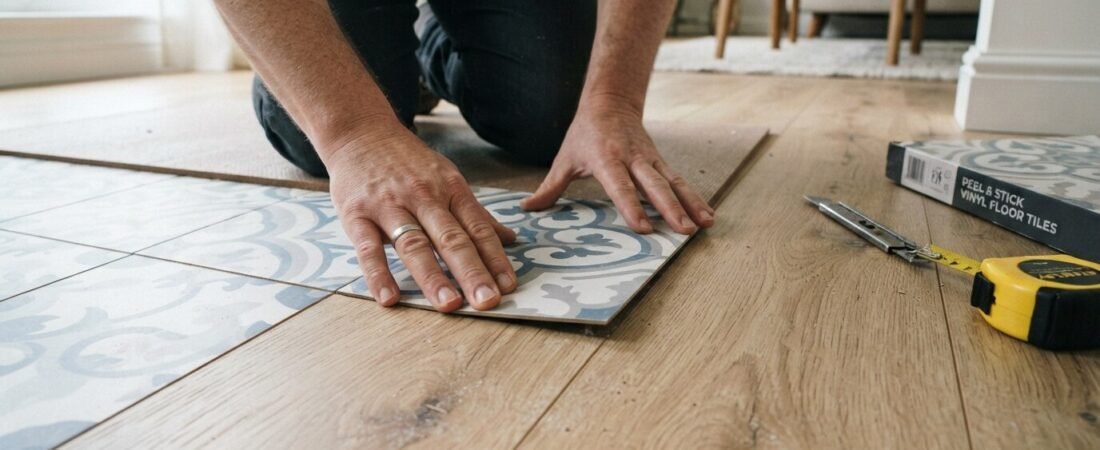
Laminate floors can look great when they’re new. But after a few years, you may want to update the look without going through the work of tearing the whole floor out. Peel and stick tile can seem like an easy fix, and in many cases, it can be. However, laminate has one important difference from vinyl, tile, and concrete: it often isn’t attached to the floor underneath. That is something you should understand before you buy anything.
Short answer: Yes, you can put peel and stick tile over laminate, as long as the laminate is flat, clean, dry, firmly in place, and free of swelling or damage. The main thing that makes laminate different from other floors is that most laminate flooring is not attached to the ground. Instead, it floats as one connected piece, and that can affect how you should think about covering it.
The First Thing to Check: Is Your Laminate Floating?
Before you put peel-and-stick tiles over the laminate, first find out how your laminate is installed. Floating laminate is not glued or nailed to the subfloor. Instead, the planks lock together and sit over the surface underneath, so the whole floor can move slightly.
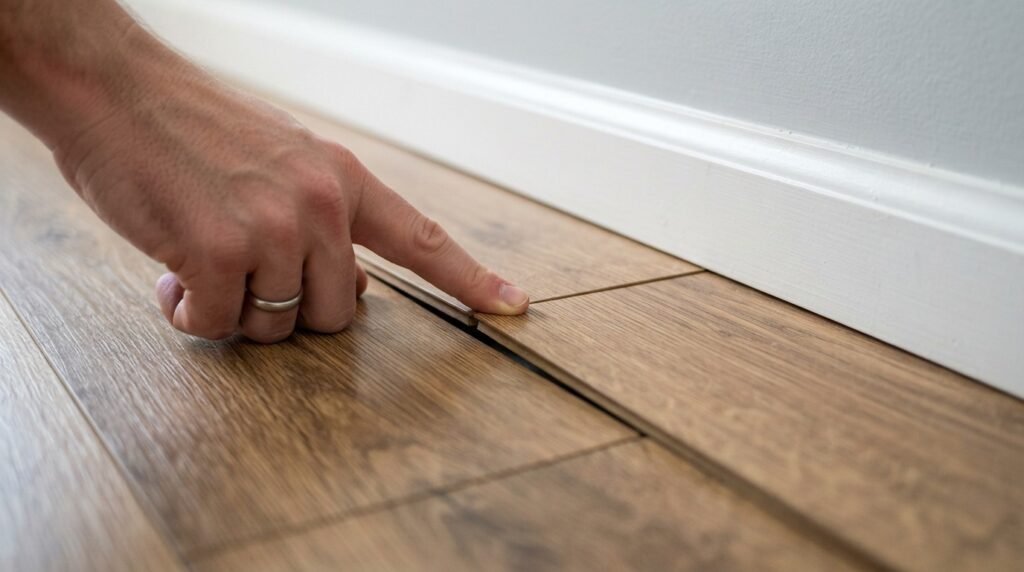
A fixed or bonded laminate floor is different because it is attached to the subfloor and does not move in the same way. If you are not sure what you have, check for simple signs. For example, floating laminate is usually installed over underlayment without being glued down, and you may notice slight movement when you walk across it.
This difference matters because peel-and-stick tiles have an adhesive backing and need a stable base. If the laminate moves underneath, the tiles can move with it, which may cause adhesion problems or lifting over time. That’s why some manufacturers do not approve peel-and-stick tiles over floating laminate.
So, this does not mean you cannot cover laminate. However, “is it flat and clean?” is not the only thing you need to check. You also need to make sure the floating laminate is stable and still has enough room to move as it was designed to.
Which Laminate Floors Work With Peel-and-Stick Tiles?
Not every laminate floor is a good base for peel-and-stick tiles. The best starting point is laminate that is flat, stable, clean, and free from damage.
If you’re still comparing different flooring surfaces, you can also see whether peel-and-stick tiles can go over existing tile to see how the surface underneath affects the installation.
| Laminate condition | Suitable for peel-and-stick? | Main concern |
| Flat, clean, dry laminate | Usually yes | Still needs proper surface prep |
| Glossy or slick laminate | Sometimes, with prep | Adhesive may need better surface grip |
| Textured or embossed laminate | Risky | Pattern can show through the tile |
| Laminate with beveled edges | Usually yes | Seams may remain slightly visible |
| Loose or lifting planks | No | Movement can break the adhesive bond |
| Swollen or buckled laminate | No | Usually indicates underlying damage |
| Laminate near a moisture source | Use caution | Check for hidden moisture or damage first |
Is Your Laminate Ready for Peel-and-Stick Tiles? Things to Check Before Installation
Before you cover your laminate with peel-and-stick tiles, take a few minutes to check its condition. A laminate floor can look fine at first but still have movement, moisture damage, or surface problems that can cause trouble later. Use the checks below to see whether your laminate is a suitable base.
| What to check | What you should see | Why it matters |
| Flat and even laminate planks | Check that the laminate planks have no visible dips, ridges, or height differences between neighboring planks | Uneven laminate can affect how the peel-and-stick tiles sit |
| Firmly Connected Laminate | Press down on different planks and check for movement, rocking, or creaking | Moving laminate can weaken the adhesive bond |
| Dry and undamaged | Look for swelling, buckling, puffiness, bubbling, or water-damaged areas | Damaged laminate should be fixed rather than covered |
| Tight plank seams, No large gaps | Check the seams between the laminate planks for unusually wide gaps or separation | Large gaps can mean the laminate has shifted |
| Clean and dust-free | Check for dust, dirt, grease, wax, or other buildup on the laminate surface | Surface buildup can interfere with adhesive contact |
However, If your laminate is moving or the peel-and-stick tiles are already starting to lift after installation, the problem may not be the tile itself. Check out our guide on why peel-and-stick floor tiles are not sticking to find the common causes before adding more adhesive.
Will Peel-and-Stick Tile Actually Stick to Laminate?
Usually, yes. However, laminate has a different surface than vinyl or tile, so the surface may need a little more attention before you add peel-and-stick tile. If laminate is not the right surface for your project, concrete can be another option. Here’s what to check before putting peel-and-stick floor tiles over concrete.
Laminate has a hard, often glossy top layer made from a tough coating, sometimes called a wear layer. This layer helps the laminate resist scratches and stains. At the same time, that same toughness can make the surface a little slicker, so the adhesive may not grip it as easily as it would a softer vinyl surface.
You also need to watch for anything that could get between the laminate and the new tile’s adhesive. Dust, grease, wax, and floor polish can all weaken the bond. That’s why proper cleaning is just as important here as it is with other flooring surfaces.
So, don’t assume that laminate is ready for peel-and-stick tiles just because it looks clean. You need a clean surface that is also suitable for the specific adhesive. If the manufacturer gives special instructions for preparing laminate, follow them before you start.
How to Prepare Laminate for Peel-and-Stick Tiles
Once you know your laminate is suitable, you can prepare it for the new peel-and-stick tiles. Start with the floor itself, and then move on to the surface prep.
1. Inspect the whole laminate floor first
Check for loose planks, swelling, large gaps, or other damage using the checks above. If you find a problem, deal with it before moving forward.
2. Fix any problem areas
A few loose or damaged laminate planks can sometimes be repaired. However, widespread swelling or movement usually means covering the floor is not the right option.
3. Clean the laminate thoroughly
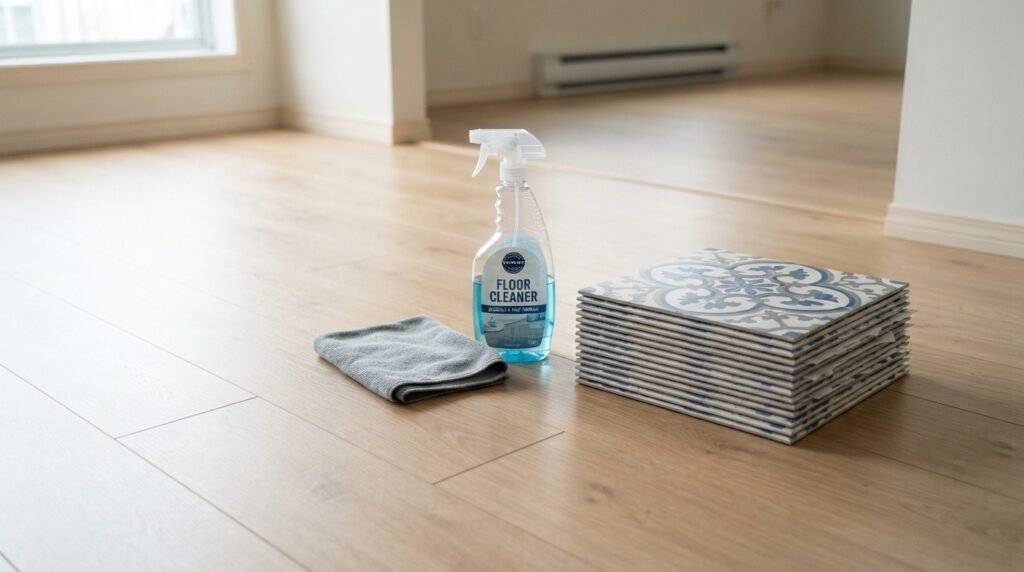
First sweep the floor, then vacuum it to remove loose dust. After that, wash the laminate with a cleaner that removes grease and wax without leaving a residue. This is especially important if the floor is in a kitchen.
4. Sand glossy areas if needed
If your laminate has a noticeably glossy finish and the tile manufacturer recommends sanding, lightly sand those areas. Then, vacuum up all the dust so it does not get between the laminate and the adhesive.
5. Let the laminate dry completely
Do not rush this step. Once the floor has been cleaned, make sure it is fully dry before you move on to the tiles.
6. Let the new peel-and-stick tiles acclimate
Keep the tiles in the room for 24 to 48 hours before installation so they can adjust to the room’s temperature and humidity. This can help the tiles adjust to the conditions where they will be installed.
7. Test a small area first
Before covering the whole floor, stick one tile in a low-visibility spot. Then, check it again after a few days to see how well it is holding. If the tile does not stay firmly attached, it is better to find out with one test tile than after the entire floor has been covered.
For the full installation process, see our guide on how to install peel-and-stick floor tiles step by step.
Should You Sand or Prime Laminate Before Installing Peel and Stick Tiles
Sanding can help when your laminate has a glossy or slick finish. A light pass with fine-grit sandpaper, usually around 120 to 150 grit, can dull the shine and give the adhesive more surface to grip. However, you do not need to sand every laminate floor. It is mainly worth considering when the laminate has a noticeably shiny surface.
Primer is a little different because it depends on the peel-and-stick tile you are using. Some products recommend primer on hard or glossy surfaces to help the adhesive bond, but others do not. So, check your specific tile manufacturer’s instructions before you use primer. The wrong prep step can sometimes create more problems instead of helping the adhesive stick.
If the manufacturer does not call for sanding or primer, don’t add either step just because the laminate looks glossy. Follow the product’s recommended preparation instead.
What Happens If the Laminate Has Texture or Beveled Edges?
Many laminate floors are made to look like real wood, so they often have a slightly textured surface. Most laminate planks also have a small angled edge called a bevel, where one plank meets the next. This creates a thin V-shaped groove between the planks.
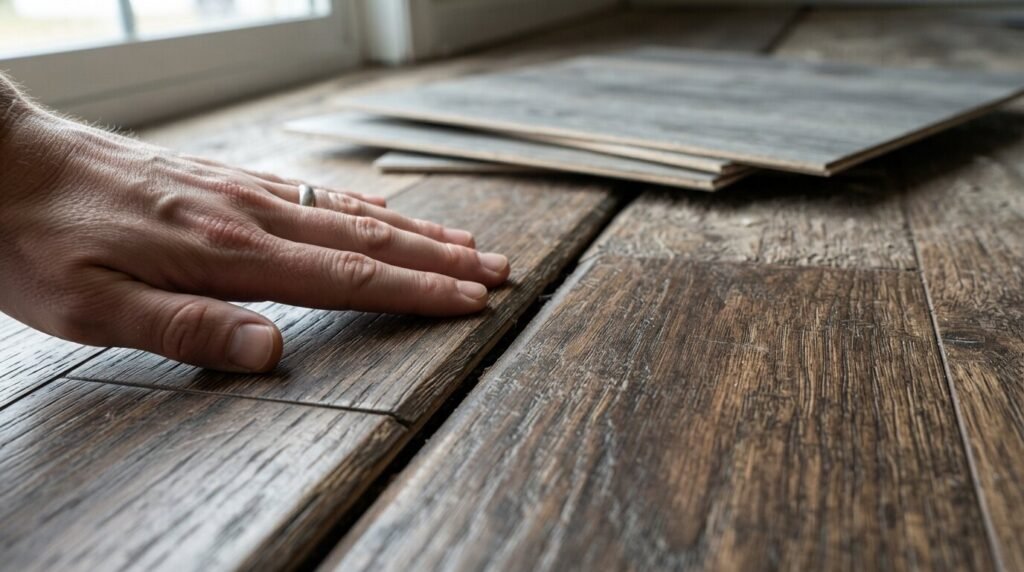
If you put thin peel-and-stick tiles over textured laminate, the texture can affect how well the adhesive touches the surface. The more texture there is, the less direct contact the adhesive may have. This is similar to what can happen with embossed vinyl, where the raised pattern can make it harder for the adhesive to grip. You can see a similar issue with textured or embossed vinyl, which we cover in our guide on putting peel-and-stick tiles over vinyl flooring.
The bevels can cause a different problem. Because they create small grooves between the laminate planks, those lines can sometimes show through the new tile. You may notice them more under bright light, especially if the peel-and-stick tile is thin.peel
However, texture and beveled edges do not always mean you cannot cover the laminate. If the texture or grooves are deep, they are more likely to affect the finished floor. So, check how your laminate looks and follow the peel-and-stick tile manufacturer’s instructions before covering it.
What If the Laminate Has Gaps Between Planks?
Small, tight joints between laminate planks are normal. So, they are not usually a problem. However, large gaps need more attention before you cover the floor with peel-and-stick tiles.
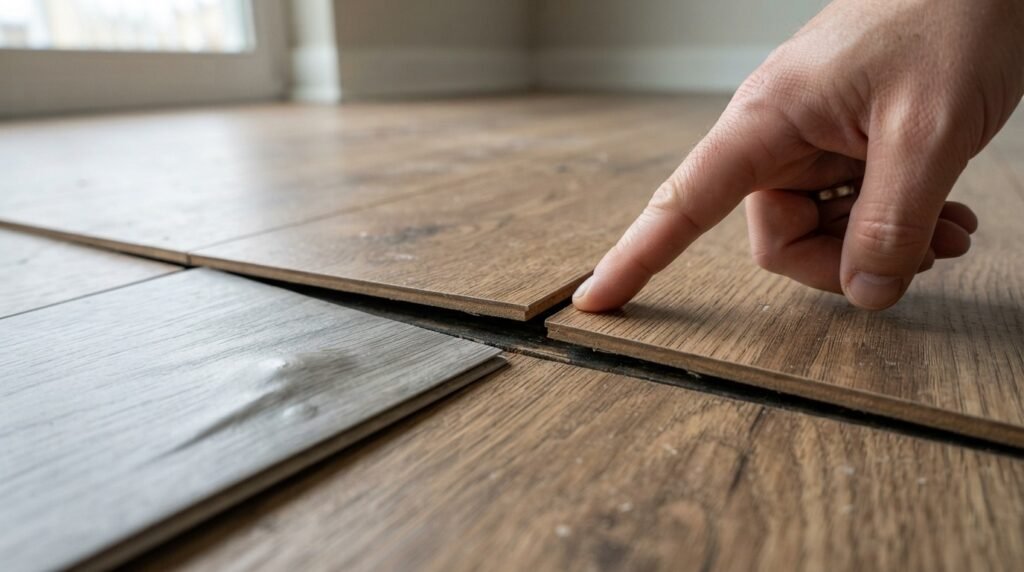
Thin peel-and-stick tiles can show what is underneath. If a gap is wide or deep, you may see it as a line or slight dip through the new tile. This is more likely with thin or flexible tiles.
Filling the gap does not always fix the problem. If the laminate planks are moving, the gap may open again. So, filler can hide the gap, but it cannot stop the laminate from moving underneath.
Check the gap before you cover it. If it is small and stable, it may not cause a problem. But if it is wide, getting bigger, or happening along with loose planks, deal with the laminate first.
When Should You Remove Laminate Instead of Covering It?
Covering the laminate can make sense when the floor is flat, dry, firmly connected, and in generally good condition. However, covering it is not a good idea if the laminate already has major problems underneath.
Removal is usually the better option if:
- Several laminate planks are loose, lifting, or shifting.
- The laminate has swelling or buckling from water damage.
- The peel-and-stick tile manufacturer’s instructions say not to install over laminate or floating floors.
- You want a more permanent flooring solution, especially if you are planning to sell the home soon.
So, if your laminate fails these checks, removing it may make more sense than putting another floor over the problem. If removal is the better option, see our guide on how to remove peel-and-stick floor tiles without damaging the subfloor for the next step.
What If the Manufacturer Says Not to Install Over Laminate?
If the manufacturer does not approve laminate as a base, do not try to make it acceptable with extra sanding, primer, or adhesive. Follow one of these options instead:
- Remove the laminate: Take up the laminate completely so the peel-and-stick tiles can be installed over the approved subfloor.
- Prepare the approved subfloor: Once the laminate is removed, check the exposed surface for the conditions listed in the tile manufacturer’s installation instructions.
- Use approved underlayment if allowed: If the manufacturer allows underlayment, use the specific type and thickness listed for that tile. Do not add a random underlayment over laminate.
- Choose another flooring option: If you want to keep the laminate, choose a flooring product whose installation instructions specifically allow installation over laminate.
Quick Checklist Before Installing Peel-and-Stick Tiles
- Laminate is flat and even, with no dips or raised planks
- All laminate planks are firmly connected, with no looseness or movement
- Laminate has no swelling, buckling, or signs of water damage
- There are no large gaps between laminate planks
- Laminate surface is clean, dust-free, and free of grease or wax
- Glossy areas are lightly sanded if needed, based on the tile manufacturer’s instructions
- The peel-and-stick tile manufacturer’s instructions allow installation over laminate
FAQs
Can you put peel-and-stick floor tiles over floating laminate?
It depends on the tile, but you should not assume that floating laminate is a suitable base. Some manufacturers specifically say not to install their peel-and-stick tiles over floating laminate because the base can move. For example, FloorPops does not recommend installing its tiles over floating wood laminate.
Will peel-and-stick tiles stick to glossy laminate?
They can, but a glossy laminate surface may give the adhesive less grip. If your tile manufacturer recommends sanding or another type of surface preparation, follow those instructions. Do not automatically sand or prime every laminate floor because preparation requirements can vary by product.
Can you put peel-and-stick tiles over textured laminate?
You can sometimes, but deep texture can make the adhesive contact less of the laminate surface. Also, the texture may show through a thin peel-and-stick tile. Check the tile manufacturer’s instructions first, especially if the laminate has a strong wood-grain pattern.
Can you put peel-and-stick tile over damaged laminate?
No. Loose, lifting, swollen, or buckled laminate should not simply be covered with new tiles. The problem underneath can continue to affect the new floor, and swollen laminate usually indicates water damage that needs to be addressed first.
Can you remove peel-and-stick tiles from laminate later?
You can remove them, but the adhesive may leave residue or affect the laminate’s finish. So, if you’re planning to remove the tiles later, test one tile in an inconspicuous area first. The manufacturer’s removal guidance is also worth checking before covering the entire floor.
Final Thoughts
Peel-and-stick tiles can work over laminate, but the laminate underneath still matters. If it is stable, dry, and in good condition, you may be able to give the floor a new look without removing it. However, if the laminate already has movement, moisture damage, or other major problems, covering it will not make those issues go away.