
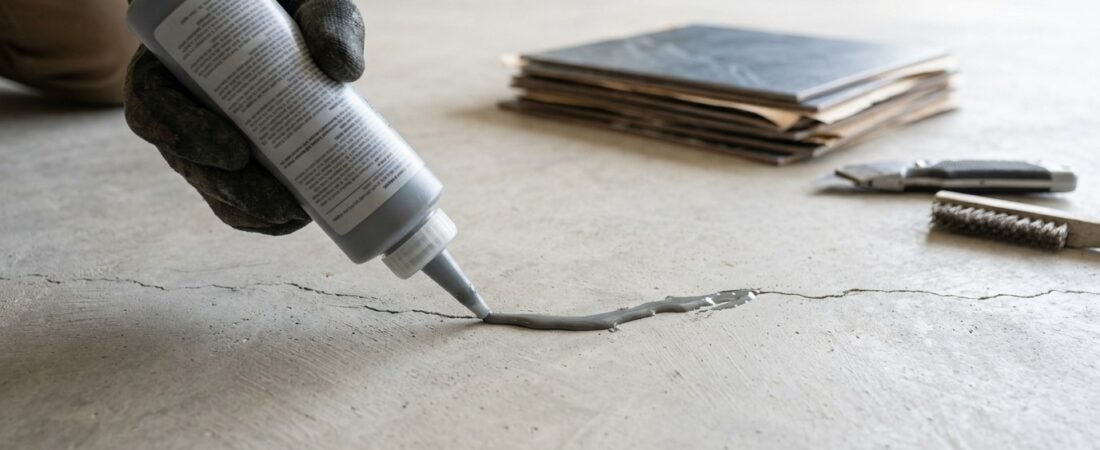
If you have cracks in your concrete floor, you need the right filler before you install peel-and-stick tiles. For small, shallow cracks, you can consider a cement-based floor patch. For deeper or wider cracks, you may need a two-part epoxy filler or a concrete repair compound.
However, your best choice depends on the size of your crack and the type of repair you need. Also you should not choose a filler based on strength alone. Peel-and-stick vinyl tiles are thin, so bumps, dips, and uneven repairs can show through the finished floor. A filler that shrinks or stays soft can also leave the tiles without a stable surface.
This guide explains which concrete crack fillers work best for peel-and-stick tiles, how to choose the right option for different crack sizes, and which products to avoid. Here are four concrete crack fillers to help you choose the right one for your floor.
Before you choose a filler, make sure your concrete floor is suitable for peel-and-stick tiles. Read our complete guide to installing peel-and-stick tiles over concrete to learn what your concrete surface needs before you cover it.
Best Concrete Crack Fillers for Peel-and-Stick Tile: Quick Comparison
If you want to choose the right concrete crack filler without reading every product detail first, use this table to compare your options.
| Crack filler | Type | Best for |
| Polygem 2-Part Epoxy Crack Repair Kit | Two-part epoxy repair kit with injection epoxy | Thin cracks that need a low-viscosity repair product |
| PC-Concrete Epoxy | Two-part epoxy paste | Medium and wider cracks, provided the product suits the crack’s width and depth |
| Henry 549 FeatherFinish | Fast-setting cement-based floor patch | Filling suitable cracks and smoothing rough spots before flooring |
| ARDEX SD-F Feather Finish | Cement-based patching and smoothing compound | Repairing and smoothing indoor floors before suitable resilient flooring, including vinyl tile |
Which Concrete Crack Filler will Work Best with Peel-and-Stick Tiles?
If you need to fill a crack in your concrete floor before installing peel-and-stick tiles, you can choose between epoxy, cement patch, and caulk. Each product works differently, so compare what it is best for and how it performs under floor tiles before deciding which one suits your repair.
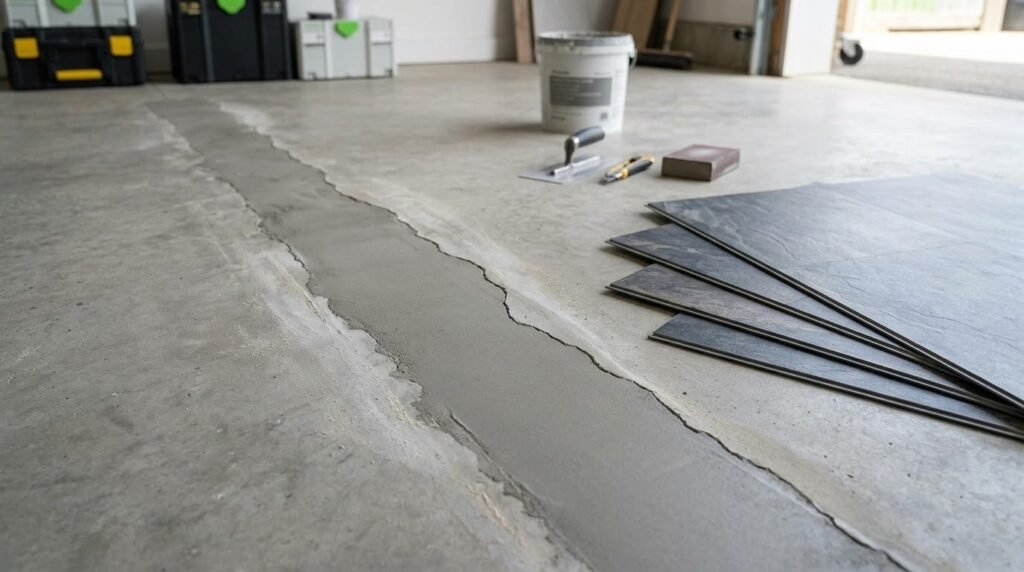
Also, after your crack filler has fully dried, check whether your concrete needs a primer before you install the tiles. Our guide to the best concrete primers for peel-and-stick tiles can help you choose a suitable primer for your floor.
| Filler type | Best for | Works under peel-and-stick tile |
| Epoxy | Thin to wide cracks that are stable and do not move | A strong option for filling cracks. It cures hard, and some products can be sanded smooth. |
| Cement patch (latex or polymer-modified) | Medium cracks, small chips, and rough spots around a repair | A good option when you need to level the repaired area. Many products cure quickly, but check the label for sanding and curing instructions. |
| Caulk or silicone | Sealing joints or gaps where a flexible seal is needed | Generally not suitable for filling cracks beneath peel-and-stick floor tiles because many products remain flexible and may not provide a firm, tile-ready surface. Skip them unless the product is specifically approved for this use. |
These options give you a quick idea of which filler may work best, but you should also check the width and depth of your concrete crack before making your choice. A filler that works well for a narrow crack may not be suitable for a wider or deeper gap. So, measure your crack first, then use the guide below to find the most suitable option for your repair.
Estimate Your Crack Size Before Choosing the Right Filler
If you don’t have a crack-width gauge, you can use a ruler to get a closer measurement or compare the crack with a familiar object for a rough estimate. A credit card is about 1/32 inch thick, while two US quarters stacked together are close to 1/8 inch thick.
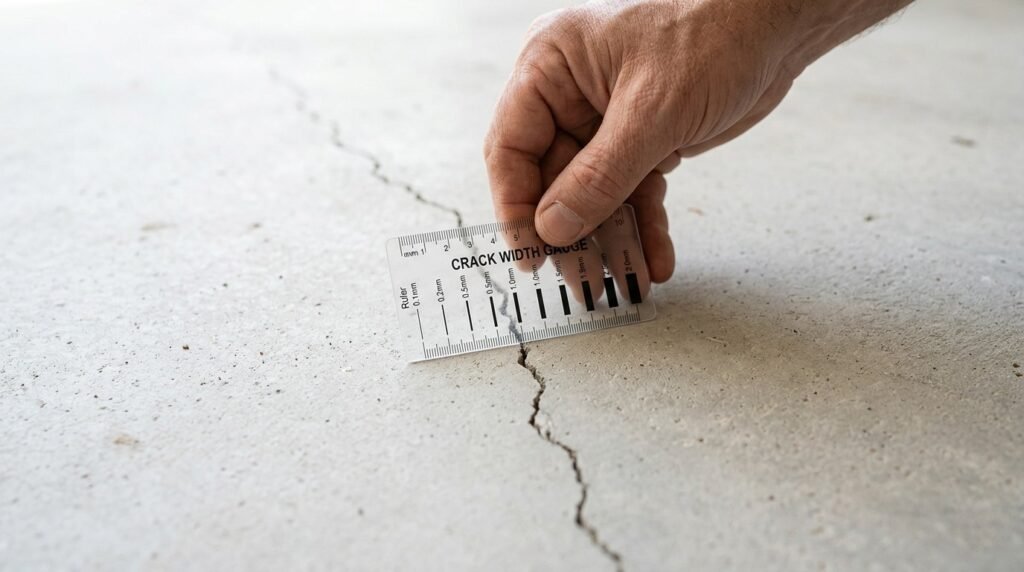
If you want a more accurate measurement, place a ruler across the widest part of your crack and check the gap in inches. For example, if your crack is about 1/16 inch wide, look for a filler made for narrow concrete cracks. However, if the gap is around 1/8 inch or wider, check the filler’s instructions to make sure it can fill that width and depth properly.
Choose the Best Concrete Crack Filler by Crack Width
Now, it is time to choose the best crack filler according to the size or width of the crack. Here is what to consider for each crack size.
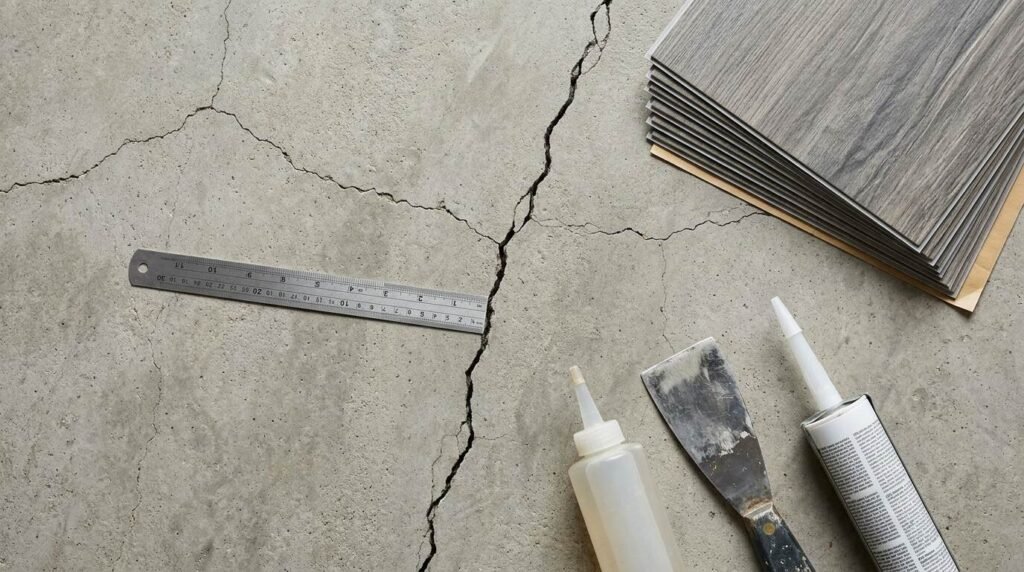
1. Hairline Cracks (Thinner Than 1/16 Inch)
If your crack is thinner than 1/16 inch, check whether you can feel it with your fingernail. If you can barely see the line and your floor feels flat, you may not need to fill it. However, if the crack leaves a small dip, choose a compatible cement-based floor patch that can smooth the surface before you install your tiles.
2. Thin Cracks (About 1/16 to 1/8 Inch)
If your crack is between 1/16 and 1/8 inch wide, look for a low-viscosity epoxy crack filler made for concrete floors. Its thin consistency can help you fill a narrow opening that may be difficult to reach with a thick paste.
You can also consider a cement-based floor patch if its instructions cover your crack size. However, if you choose a thick epoxy paste, you may find it difficult to work into the narrow gap. Check the product’s recommended crack width before you buy it.
3. Medium Cracks (About 1/8 to 3/16 Inch)
If your crack is between 1/8 and 3/16 inch wide, compare an epoxy crack filler with a cement-based repair patch. Choose an epoxy paste if the manufacturer approves it for your crack’s width and depth. If you also need to fill small chips or smooth rough spots around the crack, look for a cement-based floor patch rated for that repair.
Before you decide, check that your chosen product can leave a hard, level surface suitable for your peel-and-stick tile adhesive.
4. Wide Cracks (More Than 3/16 Inch)
If your crack is wider than 3/16 inch, choose an epoxy filler or concrete repair compound specifically rated for its width and depth. Check the product label carefully, because a filler designed for shallow cracks may not work for a deeper opening.
You may also need a compatible cement-based floor patch to smooth the surrounding area. However, if you notice that the crack keeps widening or the concrete edges are shifting, do not rely on filler alone. Find out what is causing the movement before you cover the area with tiles.
5. Cracks With Uneven Edges (One Side Higher Than the Other)
If one side of your concrete crack sits higher than the other, filling the gap alone will not make your floor flat. Because peel-and-stick tiles are thin, you may still see or feel the raised edge after installation.
First, choose a concrete crack filler rated for the crack’s width and depth. Then, use a compatible cement-based floor patch to smooth the surrounding area, if needed. Make sure your repair leaves a flat surface before you install your tiles.
However, if one side keeps rising or shifting, do not simply cover the crack with more filler. Find out what is causing the movement before you repair the floor.
Once you choose the right filler for your crack, you need to apply it properly and leave the surface smooth. Follow our guide on how to fill cracks and holes in a concrete slab ;before peel-and-stick tile for step-by-step repair instructions.
4 Concrete Crack Filler Products to Consider For Installing Sticky Tiles
If you have measured your concrete crack and selected the type of filler you need, these four products are worth comparing. Each one has different uses, working times, and limitations, so check which option fits your crack and the flooring you plan to install.
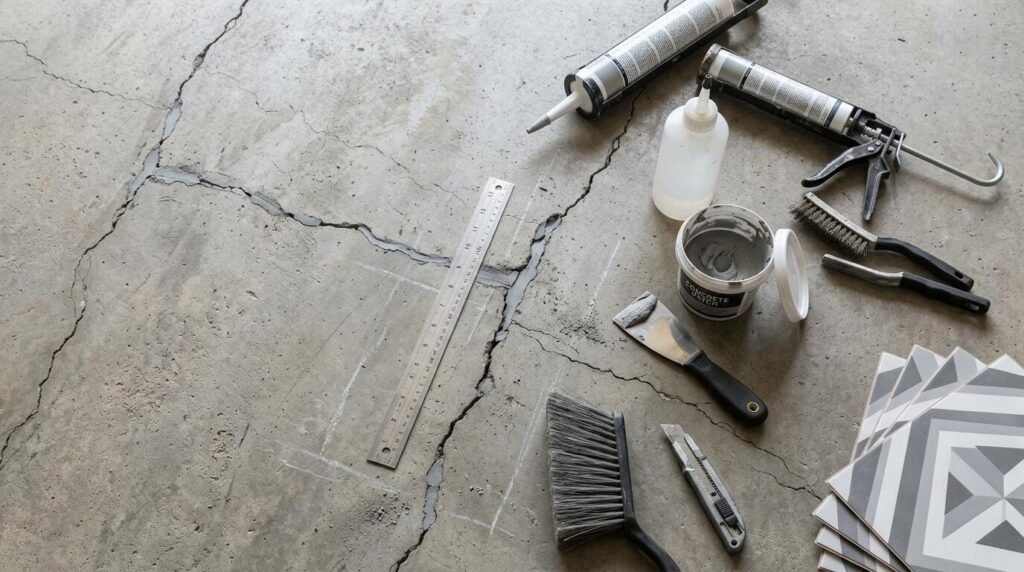
| Product | Best for | Key advantage | Limitation |
| Polygem 2-Part Epoxy Crack Repair Kit | Thin to medium, stable cracks | Includes injection epoxy designed to flow into cracks; the listing says it is sandable and paintable | Takes longer to cure than a fast-setting cement patch |
| PC-Concrete Epoxy | Medium and wider, stable cracks | Thick, non-sagging paste; manufacturer says it has no odor or solvent | May be difficult to work into narrow cracks; mixing nozzle can be tricky |
| Henry 549 FeatherFinish | Floor patching, cracks, gouges, and seams | Portland cement-based patch that can dry in as little as 15 minutes under suitable conditions | Sets quickly, so you need to work in small batches |
| ARDEX SD-F Feather Finish | Smoothing and patching indoor floors before resilient flooring | Designed for use before sheet vinyl and VCT; manufacturer says no primer or latex additive is needed | Sets quickly, and thicker applications need more drying time |
1. Polygem 2-Part Epoxy Crack Repair Kit
- Good to know: You get both paste and injection epoxy, so you can choose the application method that suits your repair. The injection epoxy is designed to flow into cracks, and the listing says the repaired material can be sanded and painted.
- Not so good: You need to wait about 24 hours for full curing, so if you want to lay your peel-and-stick tiles sooner, this may not be the quickest option.
2. PC-Concrete Epoxy
- Good to know: At 75°F, you have about 20 minutes to work with the epoxy, and the listed curing time is about 4 hours. The product is also described as sandable in some listings.
- Not so good: The thick paste may not reach the bottom of a very narrow crack easily. If you have not used a two-part epoxy before, the mixing nozzle may also take some practice.
3. Henry 549 FeatherFinish
- Good to know: You only need to add water, and the product can be applied from a feather edge to a depth of up to 5 inches, according to the manufacturer. Keep your room temperature above 65°F, and check the instructions for the conditions required before installing your tiles.
- Not so good: You need to work quickly because the patch hardens fast. Mix only what you can spread in time, and use it only if your crack is stable and does not continue to move.
4. ARDEX SD-F Feather Finish
- Good to know: You can use this patching compound to fill cracks, gouges, and joints before installing suitable resilient flooring. The manufacturer says you do not need a primer or latex additive.
- Not so good: You need to work quickly because the compound sets fast. If your repair is thick, allow more drying time before covering it with peel-and-stick tiles; the 15-minute figure applies only under suitable conditions.
5 Concrete Crack Fillers You Should Avoid Under Peel-and-Stick Tiles
When you choose a filler for your concrete floor, make sure it will give your peel-and-stick tiles a hard, stable surface to stick to. Some products work well for other repairs but can cause problems under thin vinyl tiles. Here is what you should avoid when you repair your floor.
1. Silicone and flexible caulk
Avoid using these to fill cracks beneath your tiles unless the product is specifically approved for your flooring. Silicone and flexible caulk can stay soft, so your tiles may press down or move when you walk on them. Your tile glue may also struggle to bond to the surface.
2. Tar or asphalt crack sealers
Do not use these just because they are labeled for concrete or crack repair. Many are made for outdoor pavement and can remain soft or sticky. As it is mentioned that your peel-and-stick tiles need a firm, smooth surface, so check the product label before using any sealer indoors.
3. Spackle and drywall compound
You may have these products at home, but they are designed mainly for wall repairs. They may not provide the strength your floor needs under foot traffic. Choose a concrete floor patch instead so you can create a more suitable base for your tiles.
4. Plain mortar or concrete mix
You might think a standard concrete mix will fill your crack, but it may not bond properly inside a narrow opening or leave a smooth finish. Choose a repair compound made for the width and depth of your crack so you can fill the gap without leaving loose material or uneven edges.
5. Outdoor driveway crack sealers
Before you use a driveway sealer on your indoor floor, check whether its instructions allow use beneath vinyl flooring. Some products remain flexible or leave a surface that your tile adhesive may not grip well. Choose a filler that is suitable for indoor floor repairs and compatible with your peel-and-stick tiles.
FAQs
How Much Concrete Crack Filler Do You Need for a Room?
You may need only a small amount if your concrete floor has a few narrow cracks. Measure the length and width of each crack, and check the product label for its coverage rate. If your cracks vary in depth, remember that deeper gaps may require more filler than shallow ones.
Is Epoxy or Cement-Based Patch Better for Peel-and-Stick Tiles?
It depends on your crack and the repair you need. A suitable liquid or paste epoxy may work well for stable cracks, while a cement-based floor patch can help fill cracks and smooth uneven areas. Check the product’s approved crack size, depth, and flooring compatibility before you choose.
Can You Use Concrete Caulk to Fill Cracks Before Installing Peel-and-Stick Tiles?
Usually, you should avoid ordinary flexible caulk for this purpose unless the product is specifically approved beneath your flooring. Flexible caulk may not provide the firm surface your tiles need, and the adhesive may not bond well to it. Choose a concrete repair product intended for use beneath floor coverings.
Can You Use the Same Concrete Crack Filler in a Basement or Garage?
Not necessarily. Check whether your chosen filler is suitable for the conditions in your basement or garage. If the concrete has moisture problems or the crack is still moving, address those issues before installing peel-and-stick tiles. Also, confirm that your flooring is approved for that location.
Final Note
Before you choose a concrete crack filler, check your crack’s width, depth, and condition. The right product should leave you with a hard, flat surface that is suitable for your peel-and-stick tiles. If your crack keeps moving or your concrete has moisture problems, address those issues first so you do not risk damaging your new floor.